Latest news
Interview with Oda Charlotte Lyngvaer
20 October 2026
Following her Longines FEI Jumping World Cup™ Final debut earlier this year, Norwegian show jumper Oda Charlotte Lyngvaer is preparing for another exciting indoor season. Based at Stal Hendrix in the Netherlands, Oda combines the demands of international competition with family life, supported by one of the sport’s most established equestrian families. Ahead of Jumping Indoor Maastricht, she reflects on the lessons of her Longines FEI Jumping World Cup™ journey, her ambitions for the season ahead and the importance of family, teamwork and finding the right balance.
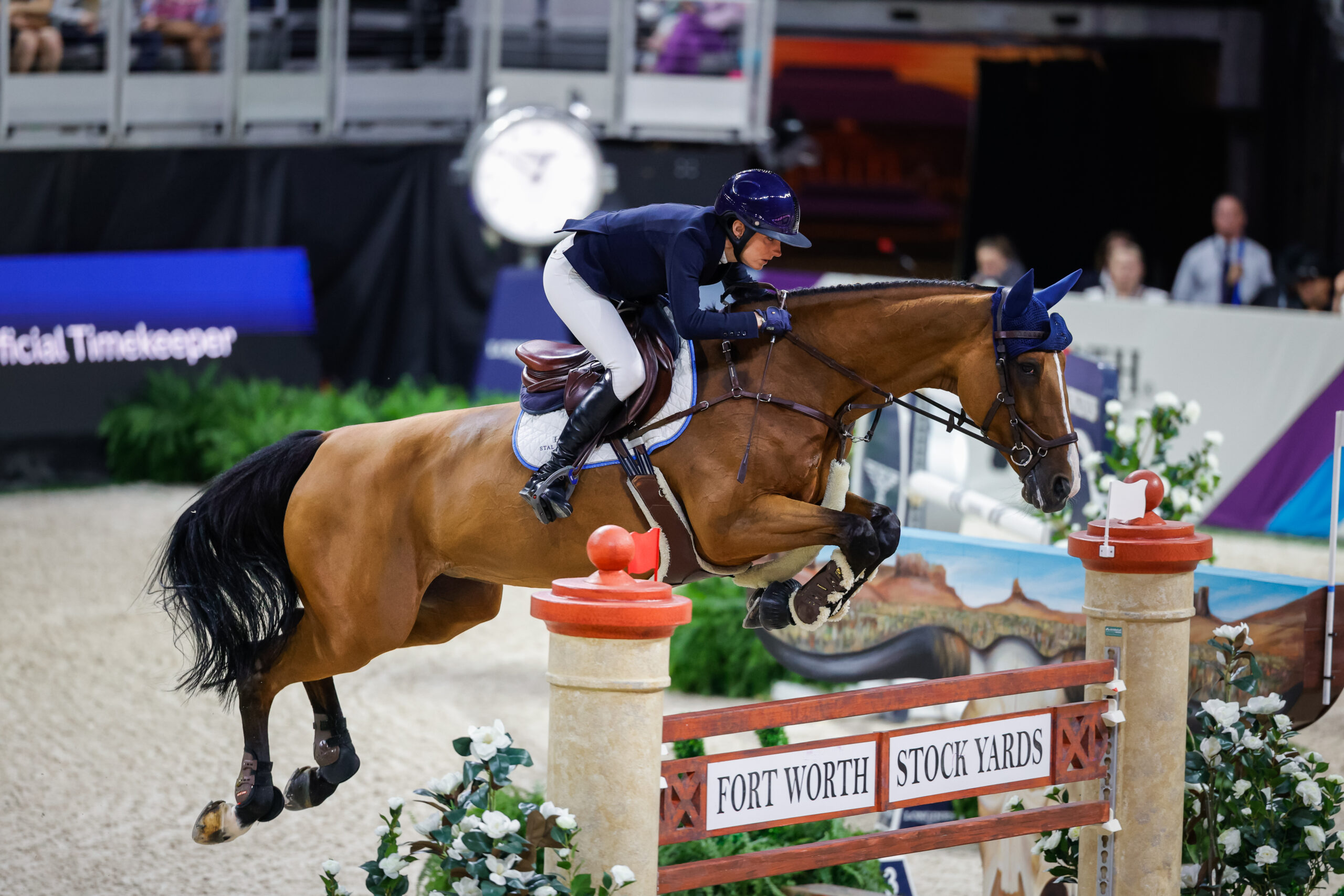
(Photo by Tiffany Van Halle – MXIMD Pictures)
- You made your Longines FEI World Cup™ Final debut in Fort Worth earlier this year. Looking back, what did that experience teach you, both about yourself as a rider and what it takes to compete at the very highest level?
Competing in my first World Cup Final [Longines FEI World Cup™ Final] was incredibly special. I was very happy to have the opportunity to complete a full World Cup season leading up to Fort Worth. Carabella had been so consistent from the beginning – we jumped our first World Cup in February 2025, where she jumped clear. At the time, I wondered whether it had just been a lucky round, but when Carabella continued jumping clear at other qualifiers, that was when we began to think that perhaps qualifying for the Final could become a realistic goal.
I was able to compete at several World Cup shows, including Jumping Amsterdam, Basel and Gothenburg Horse Show, and gain valuable experience over some very big, difficult courses. By the time we arrived in Fort Worth, I felt we had built up enough experience and confidence to know that we belonged there.
The Final itself was a very special experience because everything revolves around one horse and each individual round. The 2025 FEI Jumping European Championships taught me about the importance of enjoying the entire journey, rather than becoming too focused on one result – and I think that helped me stay mentally present and really appreciate the experience of the World Cup Final.
- Having experienced your first Longines FEI World Cup™ Final, has it changed your ambitions or expectations for the 2026/27 season?
Unfortunately, Carabella suffered an injury at the beginning of the summer, which has changed my plans quite significantly. I had some very big dreams for this season, so of course that was disappointing.
However, competing at the World Cup Final has given me even more motivation to return. It proved to me that, as a rider, I can compete among the best in the world, and that is something I want to keep building on. It has given me the drive to continue developing horses, working towards those opportunities and holding on to the ambition of achieving even better results in the future.
- How has your preparation for five-star competitions evolved over the years, and what do you approach differently now compared with earlier in your career?
I haven’t been competing at this level for that many years, but I can see how much more confident we have become as a team. Previously, when preparing for a five-star show, we might have questioned whether we needed to do something differently simply because it was such a big competition. We were still searching for the approach that worked best for us.
Now, having competed at more of these shows and achieved consistent results, we have gained confidence in the system we have developed. We know that what we are doing works, and that allows me to arrive at the biggest competitions feeling more relaxed and confident that we belong there.
Of course, there is always something to learn, and I feel that I improve with every show. Sometimes you need to make mistakes to learn from them and move forward. The biggest change is that we have found a system that works for our horses and our team, and that gives us the confidence to approach these competitions in the right way.
- With Jumping Indoor Maastricht taking place so close to home, does competing there feel different from travelling to international shows further afield?
Definitely. I’m Norwegian, but I’ve lived here in the Netherlands for 12 years now, so there are certain shows that really feel like home to me. Gothenburg Horse Show is one of them, because I know so many people there, and Jumping Indoor Maastricht has that same feeling. There are a few indoor shows that are particularly special to me because when I jump there I feel that the crowd is really behind me.
I had my first big victory with Carabella at Maastricht, which was an incredibly special moment that I will never forget.
Having family and friends at the shows makes such a difference, but it is also very special for the wider team. There are people involved in our horses and our success who aren’t always able to travel to international competitions, so being able to share those moments with them is something I really value.
- Indoor competitions bring a very different atmosphere, with the lights, noise and spectators much closer to the arena. How do you prepare your horses for these environments?
Every horse responds differently to indoor competitions. For example, I think Carabella loves competing indoors. She seems to find it easier to focus in that environment, whereas outdoors there can be more distractions. Other horses are completely different and can become a little more stressed by the noise, the atmosphere and everything happening around them.
I think the most important thing is to give horses experience and help them build confidence through positive rounds. We try to prepare them by training indoors and, where possible, competing in arenas with similar conditions. However, you never know exactly how a horse will react until you are in that environment. It’s very much a case of learning by doing, giving them the experience and allowing them to grow in confidence.
- Being part of the Hendrix family means that horses are very much part of both your professional and personal life. What is it like being part of a family where everyone shares such a strong passion for the sport?
I come from a family with no background in horses at all, so becoming part of a family where everyone talks about horses 24 hours a day was quite a change! For me, I absolutely love it because horses have always been such a big part of my life. However, when your passion is also your family business, it isn’t always easy to switch off. Sometimes, when we’re having a family dinner, we have to remind ourselves to talk about something other than horses! Now that we have children, that helps a little too.
When you bring together so many people who are genuinely passionate about what they do, I think that is a huge strength.
- Stal Hendrix has generations of experience in identifying and developing talented horses. How has being surrounded by that knowledge and expertise influenced your own approach to training and competition?
I think you can learn something from every single person within a team, and that is something I really value. Everyone has their own way of approaching things, and I believe it’s important to take the knowledge and experience you gain from others and use those different pieces to develop your own system.
You have to find your own way of doing things, but that doesn’t mean you can’t learn from the strengths of the people around you. At Stal Hendrix, I think everyone is very good at supporting one another and bringing out each other’s strengths. There is so much passion within the team, and everyone approaches what they do with complete commitment. That is something I really appreciate being part of.
- You and Tim are both deeply involved in the equestrian world. How do you support and challenge each other professionally, and are you able to switch off from talking about horses when you’re at home?
It’s not always easy! We’ve had to work quite hard over the years to find the right balance, both professionally and personally. When you’re both so passionate about what you do, and you both want the best possible results, it’s natural that you sometimes have different opinions or ways of approaching things. We’ve had to learn how to support one another without getting in each other’s way, and how to focus on bringing out each other’s strengths rather than pointing out weaknesses. I think we’ve become much better at that over the years, and we’ve found a really good balance.
It’s the same with the children. We share the responsibilities between us, with help from the people around us, and somehow, we make it work. It isn’t always straightforward, but I think we get better at finding that balance every year.
- Combining international competition with raising a family involves a huge amount of commitment. What does a typical week look like for you, and how do you make everything work?
Sometimes I wonder how we make it all work myself! It really depends on whether I’m competing or spending the week at home. When I’m at home, I usually start the day by taking the children to school before heading to the stables and getting on my first horse. I try to focus on the horses that need preparing for upcoming competitions, while those that have just returned from a show might have a few easier days. It’s always about finding the right balance between training, hacking in the woods and planning what each horse needs throughout the week. Normally, I’ll ride until the children finish school, and then I try to dedicate the rest of the evening to being a mum. Sometimes, Tim will collect the children so I can finish working, and other times it’s the other way around. We try to be flexible and make it work between us.
When I’m away competing, the arrangements become a little more complicated, but the children are getting older now, which makes things easier. If we’re competing somewhere close to home, they can sometimes come along to the show, which is lovely. It’s always a bit of a puzzle, but we manage to make it work.
- Has becoming a mother changed your perspective on competing, whether that’s how you approach pressure, deal with setbacks or celebrate success?
Yes, I think it has, particularly when it comes to dealing with disappointing results. Before having children, horses were my entire world. If I had a bad round or felt that I should have done something differently, I could spend hours thinking about it, replaying the round in my head and wondering what I could have changed. Now, when I come home from a show and see my children, it immediately puts things into perspective.
Even if I’ve had a disappointing day, I realise that it isn’t the end of the world. There are so many other important things in life, and it’s important to enjoy them too. I think that is probably the biggest change motherhood has brought. I’ve become better at letting go of disappointing results, accepting that tomorrow is another day and shifting my focus back to my family.
- With so much travelling involved in international show jumping, how important is having the support of your family and the wider Stal Hendrix team?
It’s incredibly important, and I really appreciated that support during the last winter season when we were travelling so much for the World Cup competitions. Tim’s parents help us a great deal, and my mum also tries to fly over from Norway whenever she can. Having that support makes such a difference. For me, it’s also very important that the children enjoy their time when we’re away, rather than feeling that it’s just another weekend without us.
That’s why, whenever I’m not competing, I try to keep Saturday afternoons and Sundays completely dedicated to them. I want us to create memories together, whether that’s going somewhere or doing something special as a family. Even when I’m away competing, I like them to have something to look forward to when I get home, and to know that they’ll have my full attention. Maybe we spoil them a little on those days, but for me, creating those memories is incredibly important. We’re also trying to bring them along to more competitions now, which is lovely.
- When you look ahead over the next few years, what would you most like to achieve, both in and out of the arena?
I have big dreams, but I also want to be realistic about what we’re building. Alongside competing, we have our business developing and selling horses, and that is something I want to continue growing. My biggest ambition is to have a strong group of horses that I can compete with at the highest level, alongside a really good group of younger, up-and-coming horses that we can continue developing.
It’s important that we always have quality horses to offer our clients, that we continue finding and developing talented horses, and that we maintain the strong relationships we have built with our clients in Europe and America. At the same time, I want to continue finding a good balance between competing, the business and family life. That is probably my biggest goal, both professionally and personally.
And then, whatever opportunities come along, I want to be ready for them. Whether that’s another World Cup Final, an Olympic Games or something else, when the opportunity is there, I want to be prepared to take it.